
Modern Farm Design: A Complete Guide to Sustainable, Efficient, and Productive Farm Planning
A modern farm is much more than a large piece of land used for growing crops or raising livestock. Today, successful agricultural properties are carefully planned to improve productivity, reduce operating costs, manage water efficiently, support animal welfare, and remain sustainable for the future. A well-designed modern farm combines smart layouts, efficient infrastructure, advanced agricultural technology, and responsible resource management.
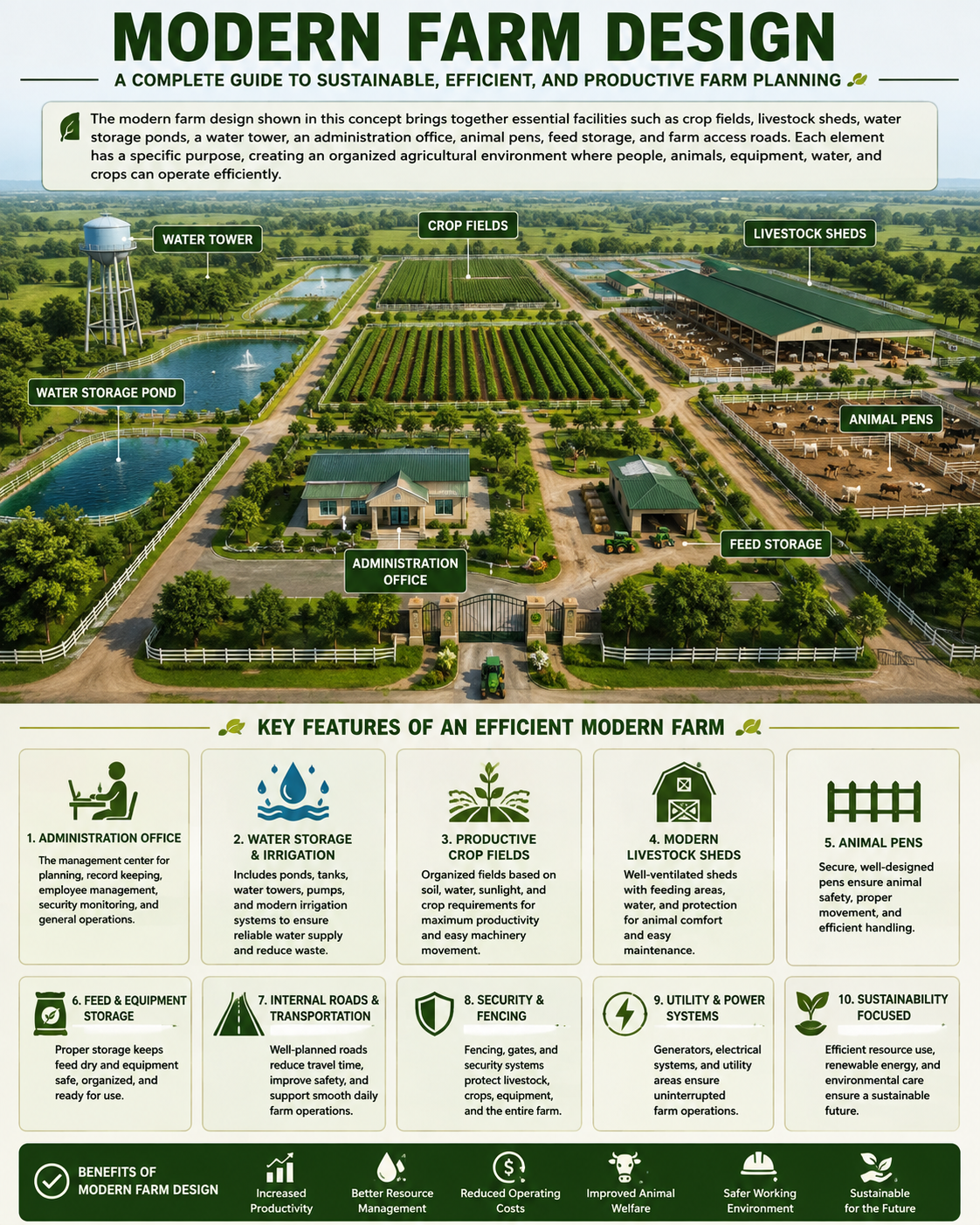
The modern farm design shown in this concept brings together essential facilities such as crop fields, livestock sheds, water storage ponds, a water tower, an administration office, animal pens, feed storage, and farm access roads. Each element has a specific purpose, creating an organized agricultural environment where people, animals, equipment, water, and crops can operate efficiently.
If you are planning a new agricultural property or looking to improve an existing farm, understanding the fundamentals of modern farm design can help you create a productive and sustainable operation.
What Is a Modern Farm Design?
A modern farm design is a carefully organized agricultural layout that places buildings, fields, livestock areas, water systems, storage facilities, roads, and working areas in strategic locations.
Unlike traditional farms where facilities may develop randomly over time, a modern farm is planned around efficiency and long-term growth. The goal is to reduce unnecessary movement, make better use of available land, simplify daily operations, and create a safer environment for workers and livestock.
A successful farm layout may include:
- Main entrance and access roads
- Administration or farm office
- Crop production fields
- Livestock sheds
- Animal pens
- Feed and equipment storage
- Water storage ponds
- Irrigation infrastructure
- Water tower
- Utility and generator area
- Internal transportation routes
- Fencing and security systems
The exact arrangement depends on the farm’s size, climate, agricultural activities, available water, terrain, and future expansion plans.
Key Features of an Efficient Modern Farm
The concept in the image highlights several important components that can be incorporated into a professional agricultural layout.
1. Farm Administration Office
The administration office acts as the management center of the farm. It can be used for record keeping, employee management, crop planning, livestock monitoring, equipment scheduling, and general operations.
Ideally, the office should be positioned close to the main entrance. This makes it easier for visitors, suppliers, employees, and farm managers to access the administrative area without unnecessarily entering production zones.
A well-planned office may include:
- Manager’s workspace
- Employee facilities
- Record-keeping area
- Security monitoring
- Communication equipment
- Storage for important documents
Keeping administrative activities centralized can make everyday farm management considerably easier.
2. Water Storage and Irrigation
Water management is one of the most important elements of modern agriculture. Reliable access to water can directly influence crop yields, livestock health, and overall farm productivity.
The illustrated farm includes dedicated water storage ponds and a water tower. These systems can support irrigation and provide water for different agricultural operations.
Modern farm water management may involve:
- Storage ponds
- Water tanks
- Water towers
- Irrigation channels
- Pumps
- Drip irrigation
- Sprinkler systems
- Rainwater collection
Water storage also provides an important buffer during periods when rainfall is limited. Efficient irrigation systems can further reduce water waste by delivering the appropriate amount of water where it is needed.
3. Productive Crop Fields
Crop fields should be positioned and organized according to soil conditions, sunlight, water availability, crop requirements, and equipment access.
The modern farm concept uses clearly organized agricultural rows, making cultivation and harvesting more systematic. Straight and accessible field layouts can simplify the movement of tractors, planting equipment, irrigation systems, and harvesting machinery.
When designing crop fields, farmers should consider:
- Soil quality
- Drainage
- Irrigation access
- Crop rotation
- Machinery movement
- Harvesting routes
- Wind direction
- Sun exposure
- Future expansion
Dividing a large agricultural property into manageable production zones can also make crop monitoring and maintenance easier.
4. Modern Livestock Sheds
Livestock facilities are another major part of an efficient farm layout. Properly designed livestock sheds provide animals with shelter, ventilation, feeding areas, water, and protection from extreme weather.
A modern livestock shed should prioritize animal comfort and easy maintenance. Depending on the type of livestock, the building may include dedicated feeding lanes, resting areas, cleaning systems, drainage, ventilation, and access routes.
Important considerations include:
- Adequate space per animal
- Natural ventilation
- Shade and weather protection
- Clean drinking water
- Efficient feeding systems
- Proper drainage
- Easy cleaning
- Safe worker access
Good livestock housing can support healthier animals while making daily farm management more efficient.
5. Animal Pens and Welfare Areas
Animal welfare should be considered from the beginning of the farm planning process. Dedicated animal pens allow livestock to move, feed, rest, and receive care in an organized environment.
Fencing should be strong enough to provide security while also allowing safe movement. Gates and pathways should be positioned so workers can access animals without creating unnecessary stress.
Well-designed animal areas can also make activities such as feeding, cleaning, veterinary care, and livestock inspection more manageable.
6. Feed and Equipment Storage
Storage is often overlooked when planning agricultural properties, but it plays an important role in keeping operations organized.
A modern farm may require separate storage facilities for:
- Animal feed
- Seeds
- Fertilizer
- Tools
- Machinery
- Harvested crops
- Maintenance equipment
- Protective gear
Storage buildings should be located where they can be easily accessed by farm vehicles without interfering with livestock or crop production.
Proper storage also helps protect agricultural supplies from moisture, pests, weather, and unnecessary damage.
The Importance of Farm Roads and Access
A productive farm requires efficient movement between different areas. Internal roads connect the main gate with offices, crop fields, livestock sheds, water systems, storage facilities, and other important locations.
Farm roads should be wide and strong enough to accommodate the equipment used on the property. Depending on the operation, this may include tractors, trucks, trailers, livestock vehicles, and harvesting machinery.
A smart road network can reduce travel time and fuel consumption while improving access during planting, harvesting, maintenance, and emergencies.
Sustainable Farming in Modern Farm Planning
Sustainability is becoming increasingly important in agricultural development. A sustainable farm attempts to use land, water, energy, and other resources responsibly while maintaining long-term productivity.
Modern sustainable farming strategies may include:
- Efficient irrigation
- Rainwater collection
- Solar energy
- Soil conservation
- Crop rotation
- Composting
- Renewable energy systems
- Reduced water waste
- Efficient farm machinery
- Responsible livestock management
The goal is not simply to produce more today but to create a farm that can continue producing effectively for years to come.
How Smart Technology Can Improve a Modern Farm
Technology can transform a traditional agricultural property into a more precise and efficient operation.
Modern farms may use sensors, GPS equipment, automated irrigation, weather monitoring systems, drones, cameras, and farm management software.
For example, soil sensors can help monitor moisture levels, while automated irrigation systems can deliver water according to crop requirements. GPS-guided machinery can improve field efficiency and reduce unnecessary passes over cultivated land.
Other technologies may help farmers monitor:
- Soil moisture
- Crop health
- Weather conditions
- Livestock activity
- Water consumption
- Equipment performance
- Farm productivity
Technology should be integrated into the farm layout rather than treated as an afterthought.
Benefits of a Well-Planned Modern Farm Layout
A carefully designed farm can provide several operational advantages.
Better Productivity
Organized crop fields, efficient irrigation, and accessible infrastructure can help farmers complete agricultural tasks more efficiently.
Reduced Operating Costs
Shorter transportation routes, efficient water systems, and better equipment organization can reduce wasted time, fuel, labor, and resources.
Improved Water Management
Dedicated storage and irrigation infrastructure helps farmers manage water more effectively, particularly in regions where water availability changes throughout the year.
Better Animal Welfare
Comfortable livestock sheds, appropriate animal pens, reliable water supplies, and safe movement areas contribute to healthier livestock environments.
Easier Farm Management
Centralized administration, organized storage, and clear access routes make it easier to supervise the entire operation.
Future Expansion
A scalable farm layout can reserve space for additional sheds, fields, storage facilities, renewable energy systems, or other infrastructure as the agricultural business grows.
Planning a Modern Farm Step by Step
Creating a successful agricultural layout requires careful planning before construction begins.
Step 1: Analyze the Land
Start by studying the site’s size, shape, slope, soil conditions, drainage, sunlight, vegetation, and existing water sources.
Step 2: Identify Agricultural Goals
Determine what the farm will produce. A crop-focused farm will have different infrastructure requirements from a livestock operation or mixed agricultural property.
Step 3: Plan the Main Entrance
Create a practical main entrance that allows vehicles, workers, suppliers, and visitors to enter safely.
Step 4: Design the Internal Road Network
Connect major facilities with durable and accessible roads while avoiding unnecessary travel distances.
Step 5: Allocate Crop Production Areas
Position fields according to soil, irrigation, sunlight, drainage, and machinery requirements.
Step 6: Design Livestock Facilities
Locate livestock sheds and animal pens in areas that provide suitable ventilation, drainage, water access, and convenient management.
Step 7: Add Water Infrastructure
Plan ponds, tanks, pumps, irrigation lines, and water towers according to the farm’s expected water demand.
Step 8: Add Storage and Utility Areas
Provide appropriate locations for feed, machinery, tools, harvested products, and utility equipment.
Step 9: Consider Sustainability
Explore renewable energy, water conservation, soil management, and environmentally responsible agricultural practices.
Step 10: Reserve Space for Growth
Avoid designing the entire property around today’s needs. Leave room for future facilities and agricultural expansion.
Modern Farm Design for Small and Large Properties
The principles of modern farm planning can be adapted to different property sizes.
A small modern farm may combine several functions into compact buildings and use efficient irrigation systems to maximize limited space. Vertical storage, multipurpose sheds, and carefully positioned pathways can be particularly useful.
A large commercial farm may require separate production zones, multiple livestock buildings, extensive irrigation infrastructure, machinery storage, staff facilities, processing areas, and larger internal road networks.
Regardless of size, the key principle remains the same: every part of the property should have a clear purpose and logical relationship with the other facilities.
Cost Considerations for Modern Farm Development
The cost of building a modern farm depends heavily on land conditions, location, materials, labor, infrastructure, farm size, and the type of agricultural activities planned.
Major cost categories may include:
- Land preparation
- Roads and drainage
- Farm buildings
- Livestock facilities
- Irrigation systems
- Water storage
- Water towers
- Fencing
- Electrical infrastructure
- Solar or renewable energy systems
- Agricultural machinery
- Storage facilities
Creating a detailed budget before construction can help prevent unexpected expenses. It is also useful to prioritize essential infrastructure first and plan optional upgrades for later stages.
Final Thoughts
A modern farm design combines sustainability, efficiency, productivity, and thoughtful planning. From crop fields and livestock sheds to water storage, administration facilities, roads, and storage areas, every element contributes to the overall performance of the agricultural property.
The farm concept shown in the image demonstrates how different agricultural functions can be organized into a cohesive layout. By planning facilities strategically, farmers can improve resource management, reduce operational inefficiencies, support animal welfare, and create opportunities for future expansion.
Whether you are developing a small family farm or planning a large commercial agricultural operation, investing time in a well-designed farm layout can provide significant long-term benefits. A modern agricultural property should not only meet today’s needs—it should also be prepared for the challenges and opportunities of tomorrow.
Frequently Asked Questions About Modern Farm Design
What is the most important part of a modern farm design?
There is no single most important feature. A successful design balances crop production, livestock management, water availability, roads, storage, utilities, worker access, and future expansion.
How can a farm become more sustainable?
Farmers can improve sustainability through efficient irrigation, water storage, soil conservation, renewable energy, crop rotation, responsible livestock management, and reduced resource waste.
Why is water storage important on a farm?
Water storage provides a dependable supply for irrigation, livestock, and other agricultural activities and can help farms manage periods of inconsistent rainfall.
Should livestock sheds be separated from crop fields?
They can be located within the same overall farm but should be strategically positioned to provide convenient access while managing sanitation, drainage, animal movement, and crop protection.
Can modern farm designs be used for small farms?
Yes. Modern farm planning principles can be scaled to almost any property size. Even a small farm can benefit from organized roads, efficient irrigation, smart storage, and clearly defined production areas.
SEO Keywords: modern farm design, modern farm layout, sustainable farm design, farm planning ideas, agricultural farm layout, modern agriculture, farm facilities, livestock farm design, crop farm layout, sustainable farming, efficient farm design, agricultural planning